
Short answer
Separate sentence reuse from concept consistency
A recurring product description may benefit from a previously translated segment. A feature name appearing in ten different sentences needs a consistent terminology decision. The resources address related but different needs.
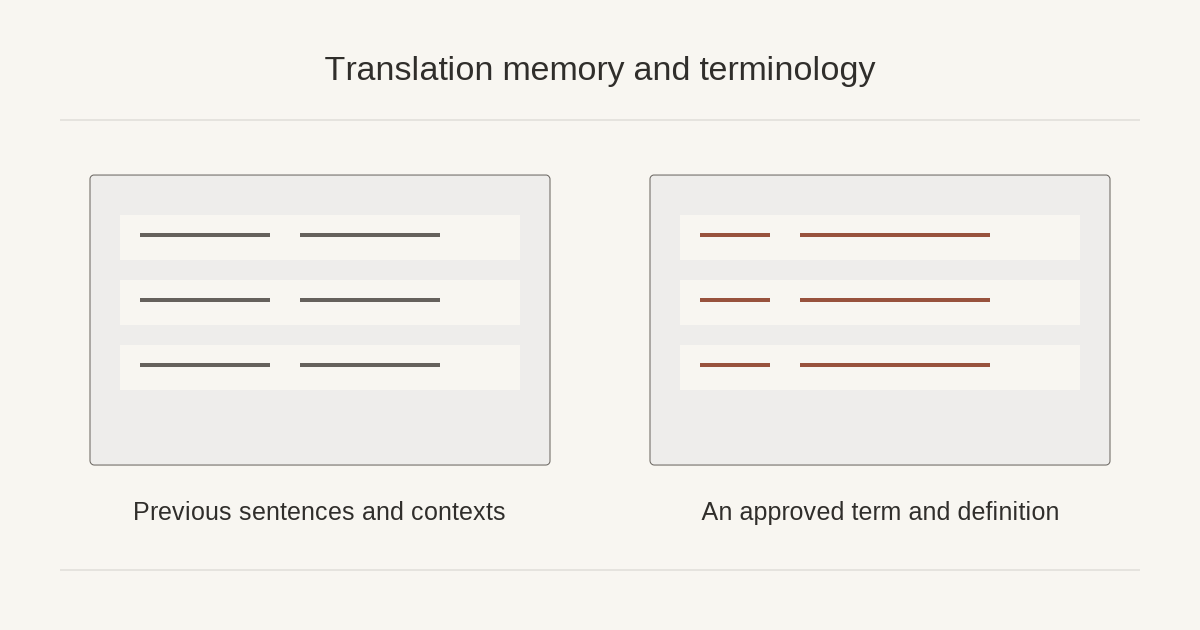
MemoQ documentation describes memories as sources of previously translated text and term bases as stores of terms and their equivalents. A term base can also include context and definitions. Ask for the resource you actually need when agreeing on project deliverables.
Do not read a match score as quality approval
A source sentence may match an older segment even though the product, audience or policy has changed. If the stored translation was weak, reuse simply carries the weakness forward.
In a hypothetical example, a familiar sentence mentions a free plan after the feature has moved into a paid subscription. Text similarity cannot validate the offer. Review changing facts, terminology and tone before accepting a suggestion or publishing the page.
Build the glossary around meaningful decisions
Start with recurring or sensitive concepts: product names, features, roles and specialist terminology. A large list of everyday words can obscure the decisions the team actually needs to follow.
Record the approved equivalent, a short definition, an example and the approval source. Add rejected alternatives only when the reason is clear. A valid term in one sector can be misleading in another, so include the domain.
- Source term and approved target equivalent.
- A definition that identifies the concept.
- An example and any usage restrictions.
- Approver, review date and entry status.
Review the memory before making it authoritative
Separate approved material from drafts and text of uncertain origin. Sample the content and look for conflicting translations, alignment problems or information that should no longer be shared.
Begin with relevant project resources rather than merging the entire company archive. Define how translators choose between resources for different brands, markets or registers. Possessing a client’s file does not grant permission to reuse it elsewhere.
Agree on ownership, maintenance and handover
Specify who approves a new term, corrects a stored translation and distributes updates. Agree on permitted resource use, delivery formats and confidential-data handling before work begins.
A handover may include a compatible memory export such as TMX and a terminology export such as TBX or a structured spreadsheet, depending on the systems involved. Test a sample import rather than assuming every definition, status and custom field will transfer intact. After the test import, compare record counts and the important fields in both systems.
Start with the recurring problem
If teams disagree on feature names, begin with a focused glossary and an approval owner. If reports repeat with small changes, memory cleanup and version management may be more urgent. Many ongoing programmes need both resources.
Track repeated corrections and inconsistency examples rather than database size alone. Update the resource when the product or terminology changes, and document why. The useful asset is an approved decision that stays current, not simply a large collection of stored segments.


