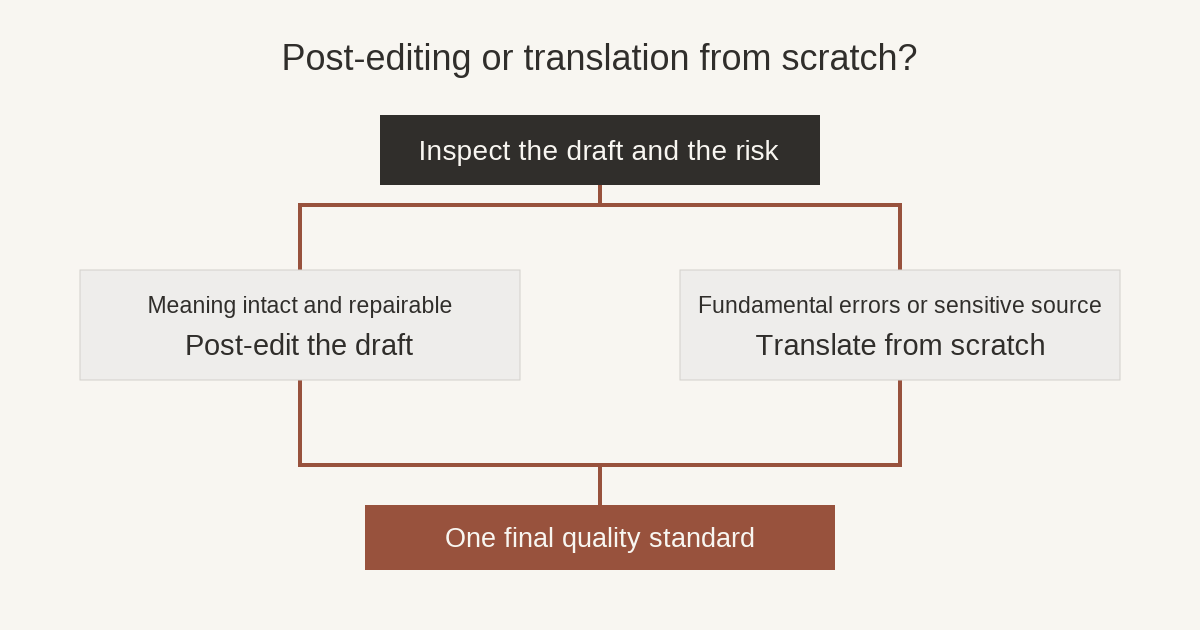
Short answer
The first translation decision concerns the source
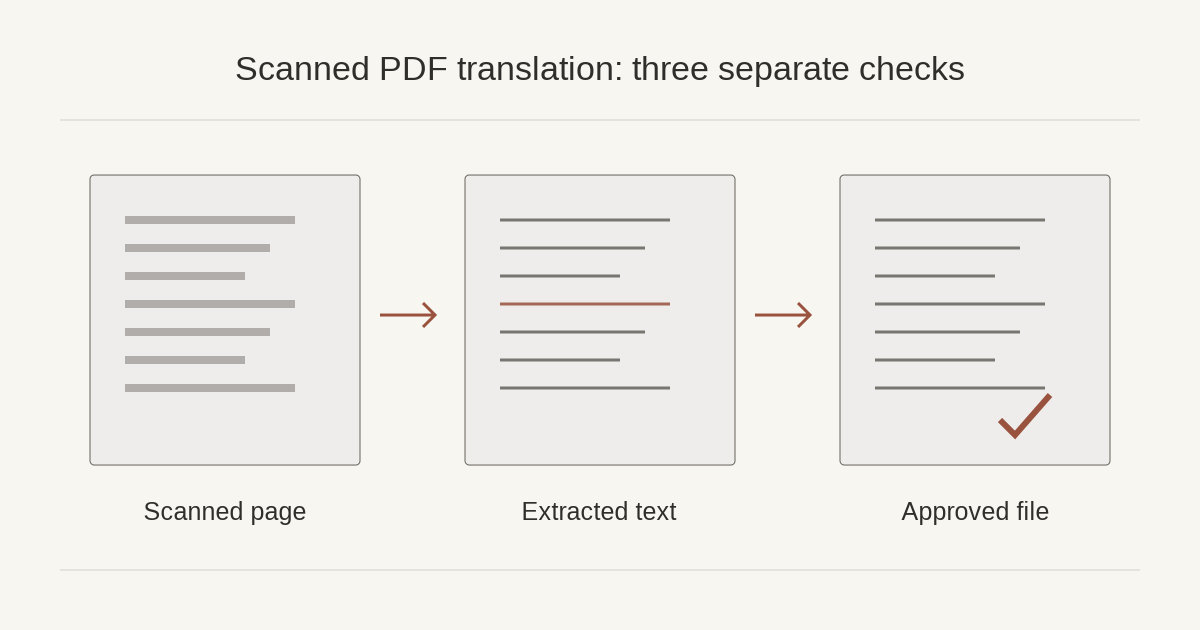
Translating a scanned PDF requires text extraction and checking, translation, and review of the final layout. One application may combine these operations, but producing an openable file does not establish that each has succeeded. A recognition error can enter the extracted source and emerge as fluent translated text carrying the wrong information. Start by asking whether the text the tool will process actually represents the original page.
This matters to the client commissioning a translated proposal or manual and to the linguist receiving an apparently usable file. Language, word count and delivery date may be agreed while source preparation remains undefined. A later dispute over formatting or correction can therefore begin before the first target-language sentence is written. A useful brief establishes the condition of the input as well as the expected output.
A PDF is not necessarily ready-to-use text
A document may contain selectable text, page images or a combination. Adobe explains that optical character recognition, or OCR, creates a searchable text layer in a scanned PDF. Recognition identifies text in an image; it does not translate that text into another language. The extracted material still needs checking before it becomes the source on which the translation depends.
As a preliminary check, select and copy passages from different parts of the file into a plain editor. Examine the order of words and lines, and include a table and a footnote where the document has them. Sard recommends this as an initial diagnosis, not a guarantee that the whole document is sound. A normal paragraph can behave well while a complex table needs separate preparation. Ask for the editable original if one exists before reconstructing the exported version.
A fluent translation can preserve a recognition mistake
Imagine a scanned supply quotation with quantities and specifications arranged in a table. During extraction, a number from one row becomes attached to the description in the next. Every word might receive an acceptable translation while the relationship between quantity and item becomes incorrect. This is a hypothetical illustration of error propagation, not a Sard client case or a test we conducted.
The review question is consequently broader than whether the English or Arabic reads well. Compare the prepared source with the page image. Does each number retain its unit and description? Does a note belong with the correct passage? Has a running header entered the body? These structural checks help locate the defect instead of asking a linguist to polish a sentence built from incorrect data.
Adobe describes a way to display uncertain recognized words and compare them with the scanned image for correction. Such flags can focus attention, but their absence should not be treated as proof that every word or table relationship is correct. Sard recommends examining names, numbers and relationships whose alteration would change the document’s meaning, including passages that initially look coherent.
Define what preserving the formatting means
One client may want headings, tables and images retained. Another may expect page-by-page visual correspondence. Neither is identical to an editable Word document or a numbered plain-text translation for comparison. Establish the deliverable before agreeing a price, including whether an editable file must accompany the final PDF. A familiar file extension does not resolve these differences in scope.
DeepL’s documentation acknowledges that differences in word length can shift the layout and that scan quality can affect translation. It also suggests trying an original document such as DOCX when PDF results are unsatisfactory. These are documented product limitations, not a comparative study of tools or an Arabic benchmark. They nevertheless show why a general promise to keep the formatting needs a practical definition.
For an Arabic output, Sard recommends checking paragraph direction, column order, punctuation and mixed-script symbols. A translated heading may need different space or line breaks. Visual adjustments should preserve relationships between information, labels and numbers rather than simply shrink the type to maintain the original page count. Layout acceptance should follow the document’s intended use.
Make preparation visible in the quotation
Discuss source preparation and recognition correction, translation and revision, layout reconstruction, and final-file checking as identifiable tasks. They need not generate separate invoices. What matters is a shared understanding of what the agreement includes. Page count alone does not show text density or table complexity, while an automatically extracted word count cannot account for material the process missed.
Use a sample representing the document’s difficulties rather than only clean opening pages. If the full file is unavailable for assessment, make the estimate conditional on the remaining material. This article supplies no universal page rate or preparation surcharge: those figures require the actual document, intended deliverable and work involved. A representative sample supports a more useful discussion than a price detached from those conditions.
Agree how illegible material will be handled. Record the question and page reference, and request a clearer copy when necessary instead of guessing a name or number to complete the sentence. For confidential content, establish the permitted processing tool before uploading it to an external service. These are execution decisions to settle with the brief, rather than leave until final delivery.
Full reconstruction is not always the right deliverable
An organized text translation may serve internal comprehension, whereas a manual distributed to customers needs an appropriate finished document. Accurate meaning remains necessary in both cases; the difference concerns delivery format and reconstruction. Choosing a simpler output can avoid visual work that adds little to the intended use.
The operational objection is that extraction and layout review can consume the time saved by automation. Measure that within the project, counting preparation, translation, correction and delivery together. Draft-generation speed does not establish a lower cost for the completed task. Sard has not conducted a tool comparison or performance trial for this article; the guidance combines product documentation with editorial analysis of the workflow.
Inspect the file that will actually leave the team
Open the final exported PDF beside the source, even if the text was approved in another working format. Check page and passage completeness, tables and notes, names and numbers, and Arabic readability. If an editable file is part of the agreement, open it too and confirm that it supports the expected edits. Approval of a working document should not automatically cover a later export nobody examined.
A dependable PDF translation starts with input diagnosis and a defined use. It then distinguishes accurate extraction, accurate translation and usable presentation. The question to take into a tool trial is how much work remains before the document serves its purpose. That is closer to the client’s decision and the translator’s workload than the number of seconds needed to generate a draft.
Sources and further reading
- Adobe — Recognize text in scanned documents
Explains the text layer and the need for review; updated 22 October 2026. Not an Arabic accuracy benchmark.
- Adobe — Fix text issues in scanned PDFs
Describes uncertain-word review and correction; absence of flags is not treated as evidence of an error-free file.
- DeepL — Troubleshooting: File translation
Documents scan/conversion limitations and trying the original file; product guidance, not an independent tool comparison.
- DeepL — Edit your file translation
Notes layout shifts caused by word lengths; no plan-pricing or language-availability claims are made.