Short answer
Funding a contribution is different from prohibiting a tool
A dubbing team might use automation at one stage, then pay an adapter, performers and a sound engineer to produce the final version. Another supplier might deliver a wholly generated output with a different creative contribution. Calling both AI dubbing obscures the commercial question: what work is being purchased, who makes its decisions and which expenditure is a funding body prepared to support?
Slator’s 16 November 2026 report brings attention to revised aid rules at France’s national film and moving-image agency, the CNC. The decision was adopted on 14 October and published in the official gazette on 31 October. Slator and Weblex place application to new requests from 1 November. The useful distinction is between defining aid expenditure and announcing a general prohibition on AI tools.
What expenditure does the official text describe?
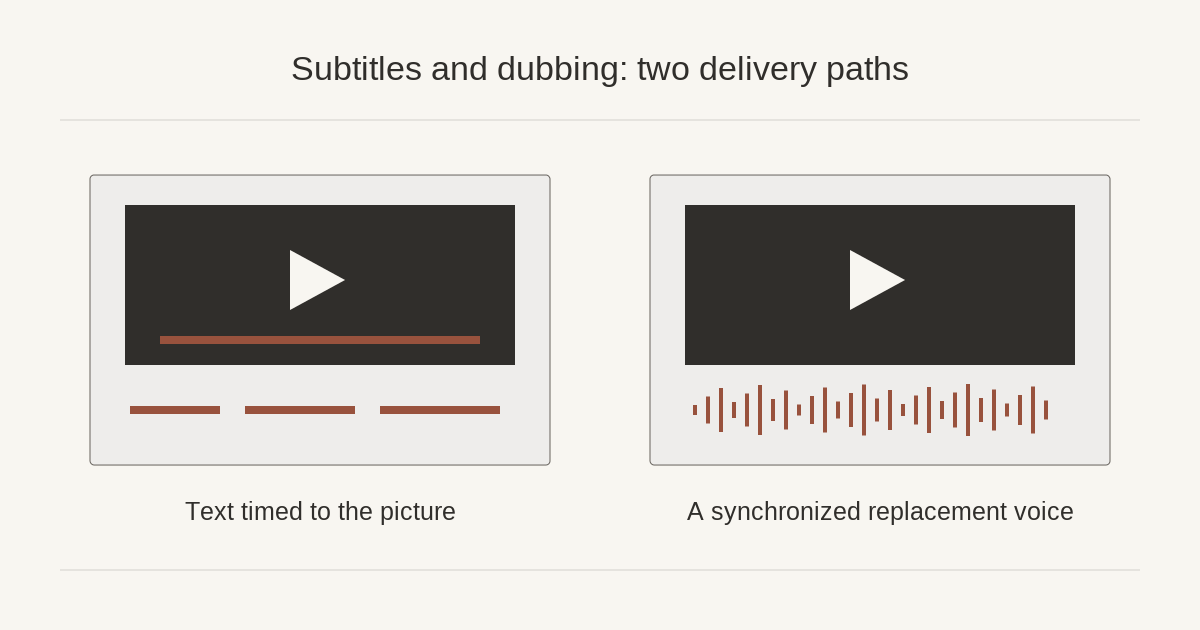
The relevant provisions of Article 1 identify text authors’ and performers’ remuneration, together with technical expenditure for recording, mixing and incorporating their performance. For subtitling, they identify subtitle authors’ remuneration and the technical work of synchronization and incorporation. These sit within CNC aid rules alongside authorship conditions for specified project types. This article does not determine an individual project’s eligibility or survey every French funding programme.
For a producer or language supplier, the budget structure makes creative language work and performance visible rather than treating a localized version as an undifferentiated file. That does not establish that all human work is excellent or every automated step unacceptable. It identifies the contribution a funding mechanism recognizes. Professional review must still ask whether the resulting work achieves its linguistic and artistic purpose.
A policy position is not an audio-quality benchmark
A culture ministry response published on 8 September 2026 to a parliamentary question provides earlier context. It recognizes potential production uses for AI while emphasizing human creation. That is an official policy position predating the amendment, not a product evaluation or evidence of the new rule’s employment effects. Nor do French funding conditions directly describe the Arabic-language market.
Three decisions deserve separate treatment: agreeing that a tool may be used, establishing that an expense fits a funding programme, and approving the finished output. A version can sound convincing yet require a separate funding review. Administrative documentation can also be complete while the performance remains weak. Adding human-reviewed to a proposal cannot settle all three decisions.
A more useful proposal explains who prepares the performable script, checks meaning, directs delivery and reviews the version against the picture. This is Sard’s recommendation for a clear scope, not a list of requirements inferred from the French decision. Its purpose is to show the client what each line item buys and the specialist what they are responsible for delivering.
A hypothetical video with two unlike quotes
Imagine a producer commissioning an Arabic version of a short service film. One supplier offers a ready-to-use audio file. Another offers script preparation, recording, mixing and an approval round. A per-minute comparison looks straightforward until the producer discovers that the scopes differ. This example is hypothetical; it is not a Sard project or a quotation from a named business.
Before comparing the totals, establish whether the audio delivery includes pronunciation decisions, terminology review, pauses aligned with the picture and replacement recording after a script change. Identify who decides whether a shorter line has preserved the meaning. Suppliers can carry out this work in different ways, but a complete Arabic version is too broad a description to show what remains with the client’s team.
If a project involves an aid application, the applicable programme’s expenditure and documentation need their own review. If it is a commercial advertisement outside that scope, a French funding condition should not be imported as though it governed the production. The transferable management principle is clarity about contribution and delivery, while regulatory conclusions stay attached to their actual context.
What is the subtitle author contributing?
A subtitle author’s contribution is not exhausted by fitting a sentence into a time slot. In another illustrative example, an important explanation might coincide with a graphic containing a name the viewer needs to read. An editor has to preserve the information while allowing the audience to receive it. This describes a possible editorial problem; it does not imply that the French text prescribes its solution or a particular timing rule.
An automated system may propose a transcript, wording or initial segmentation. Acceptance still needs an identifiable review of the relationship between language, audio, picture and audience. That is different from finding a name on an invoice. Sard recommends retaining version information, reference materials and significant changes with the approved delivery, so that review of one rendition does not silently become approval of a later altered one.
Can support for human work become an administrative burden?
The serious objection is that documenting contributions adds overhead, and a minimum participation condition does not automatically measure the depth of that participation. Teams may also use automation inside their workflow in ways a brief commercial description does not reveal. The reviewed sources do not quantify the amendment’s effects on production costs, employment or earnings. They do not establish that it has settled competition between people and tools.
Separating contributions can nevertheless make a claim easier to examine. Instead of asking only whether a version is human or automated, ask who made a particular decision, what material they examined and what their review covered. A small project needs proportionate records rather than an elaborate bureaucracy. Administrative evidence should support listening, viewing and reading rather than replace them.
What to establish before commissioning
Start with a sample that represents the material’s difficulty and identify the reference output for approval. Distinguish writing, performance, technical work and review in the scope, including how changes after approval will be handled. For an aid application, consult the relevant programme and text rather than a headline. These are ways to organize a decision, not a guarantee of funding or a legal conclusion on a particular case.
The French development shows how language work can be discussed through identifiable contributions and expenditure rather than a general defence of human importance. The open question is how actual contributions will be assessed in workflows combining automation, writers and performers. Answering it requires implementation evidence and later data; a funding text alone cannot guarantee the quality of what an audience ultimately hears or reads.
Sources and further reading
- Légifrance — Decision 2026/CA/28, Article 1 (14 October 2026; published 31 October)
Official expenditure provisions; CNC aid scope, not a general ban or an individual eligibility ruling.
- Assemblée nationale — Culture ministry response to question 10746 (8 September 2026)
Earlier official policy context; response distinguished from question allegations and employment figures not reproduced.
- Slator — French Movie Regulator Won’t Fund AI Dubbing and Subtitling (16 November 2026)
Recent independent coverage; core expenditure provisions checked against the official text.
- Weblex — Aides du CNC : le règlement évolue (9 November 2026)
Secondary corroboration of timing; not a substitute for programme-specific application review.