
Short answer
Identify the job behind the query
A business looking for an Arabic website translation may need a price estimate, a launch checklist or a supplier. Those are different questions. A dictionary-equivalent keyword does not establish equivalent intent. Examine the results, sales enquiries and available customer research before selecting a page angle.
These are planning examples, not claims about search volume. Record the audience, market and decision stage for each page. Adapt examples and information order where the market requires it, while keeping approved product facts consistent.
Make the title a specific promise
Choose a title that states what the reader will learn. A chain of near-identical service keywords makes the proposition harder to understand. Use the description to explain the actual scope of the page rather than repeating claims of leadership.
For a hypothetical page that explains source files and review stages, "Arabic Website Translation: Files, Scope and Review" is more informative than "Complete Language Solutions." Check the title alongside the opening paragraph: does the page deliver what the search result promises?
Separate URLs, languages and regions
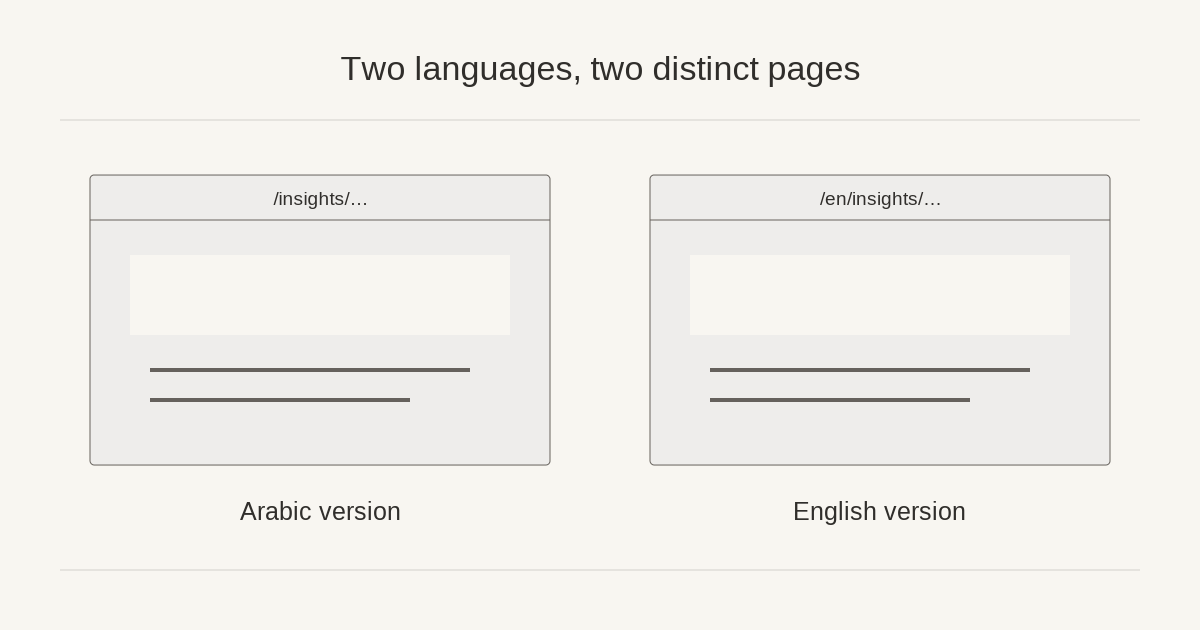
Google recommends separate URLs for language versions. Hreflang identifies corresponding versions, with reciprocal references that also include each page itself. It does not correct weak translation or automatically improve rankings.
Maintain a mapping of equivalent URLs. Do not point an article’s language switch to the section homepage merely because its translation is missing. Ask the developer to verify canonical URLs and indexing settings. Treat country targeting as a separate decision from providing an Arabic-language page.
Test the journey beyond the tags
Open an Arabic article, change language, visit its associated service and return. Each destination should remain relevant. Check mobile layouts, image descriptions, internal links and form messages as part of the same journey.
Use an acceptance log with the URL, title, counterpart, issue and responsible person. Repeat key checks after release: production indexing rules and redirects can differ from staging.
- Confirm the intended language is used throughout the page.
- Check reciprocal language references and visible switches.
- Read titles and buttons on a narrow screen.
- Verify that service enquiries retain useful context.
Avoid content padding for AI search
Google’s guidance for AI search features points back to foundational SEO and useful content. No sentence pattern or added paragraph can honestly promise inclusion in a generated answer.
Give a clear answer, support factual claims and include an example that helps the reader decide. Choose a topic because it addresses a real customer need. Publishing several versions of the same thin explanation does little for the reader.
Measure each language on its own terms
Review page and query data in Search Console alongside available enquiry or analytics data. Distinguish visibility, clicks and qualified demand. An educational page may support a later decision rather than produce an immediate form submission.
Record changes to titles, examples, links and service explanations. Compare meaningful periods, allowing for seasonality. If design and pricing changed alongside the translation, do not attribute the entire result to language work.


