
Short answer
A polished sentence can still change the claim
A financial sentence can read perfectly and still misrepresent its source. Changing "profits may rise" to "profits will rise" removes uncertainty. Dropping an exception for non-recurring items changes how a result should be interpreted. Neither mistake necessarily looks awkward. An editor concentrating on readability may even prefer the shorter version.
For organisations using AI to produce Arabic financial content, the central question is whether the output preserves the boundaries of the evidence. Translation, summarisation and rewriting redistribute information. They can alter the relationship between a forecast and its conditions, or between a reported result and an explanation offered for it. Fluency should therefore be assessed alongside fidelity to those relationships.
This article draws on Arabic language-model evaluation research and develops an editorial approach from it. The example below is hypothetical, not a test conducted by Sard or a client case. The proposed checks are recommendations for content approval, not evidence that every financial application behaves in the same way.
What specialised evaluation tells us
Published at ACL in July 2026, SAHM brings together 14,380 expert-verified instances across seven financial and Islamic-finance tasks. Its evaluation covers knowledge questions, summarisation and causal reasoning, among other tasks. The reported results show that Arabic fluency does not reliably imply evidence-grounded financial reasoning: recognition-style tasks proved easier than some generative and causal tasks.
These findings belong to the datasets, tasks and evaluation methods used in the study. They do not establish an error rate for a bank’s annual report or provide a universal ranking of current products. Their practical value is to sharpen the next question: which parts of our document workflow can a model perform reliably, and which require specialist approval?
Four changes hidden inside a shorter sentence
Consider a hypothetical source statement: "Management expects the profit margin to improve if funding costs stabilise, while demand remains under pressure." A plausible abbreviated version might read: "The company is improving profitability as funding costs stabilise." The second sentence is smoother, but its claims have changed.
It removes management as the source of the expectation. It presents a conditional development as something taking place. It loses the qualification about demand. It also broadens the specific concept of profit margin into profitability. Detecting these changes does not require predicting the company’s performance. It requires comparing the commitments made by each sentence.
A tighter version could retain the essential relationships: "Management expects a better profit margin, provided funding costs stabilise, despite continuing pressure on demand." Other formulations may suit the surrounding document. What matters is that the attribution, condition and countervailing pressure remain visible. The same comparison should be performed across the Arabic and English versions.
Define what good Arabic means for the task
Good Arabic may mean grammatical accuracy, general knowledge, instruction following or consistent terminology. Those are different capabilities. ArabicMMLU, published in 2024, illustrates why benchmark design matters: it uses Modern Standard Arabic multiple-choice questions drawn from educational examinations across several Arab countries.
That format supports assessment of knowledge and understanding. It does not directly test the task of rewriting a financial disclosure for publication. Selecting an answer differs from producing a paragraph, establishing which evidence supports it and refusing an attractive explanation that the source does not provide. Results for models evaluated in 2024 also should not be treated as measurements of later releases.
The useful comparison starts with the actual work. A team commissioning earnings summaries should evaluate summaries of representative earnings material. A team translating product descriptions should check whether fees, eligibility conditions and exceptions survive translation. A general leaderboard can help shortlist tools; it cannot replace acceptance criteria for the intended use.
Set acceptance criteria before generating the draft
A practical starting point is a representative internal set of previously approved material. A specialist identifies the information that must survive each transformation. For results reporting, that may include the period, unit, comparison basis and distinction between actual performance and forecasts. For product descriptions, it may include charges and exclusions. The importance of each item follows its potential effect on the reader’s understanding.
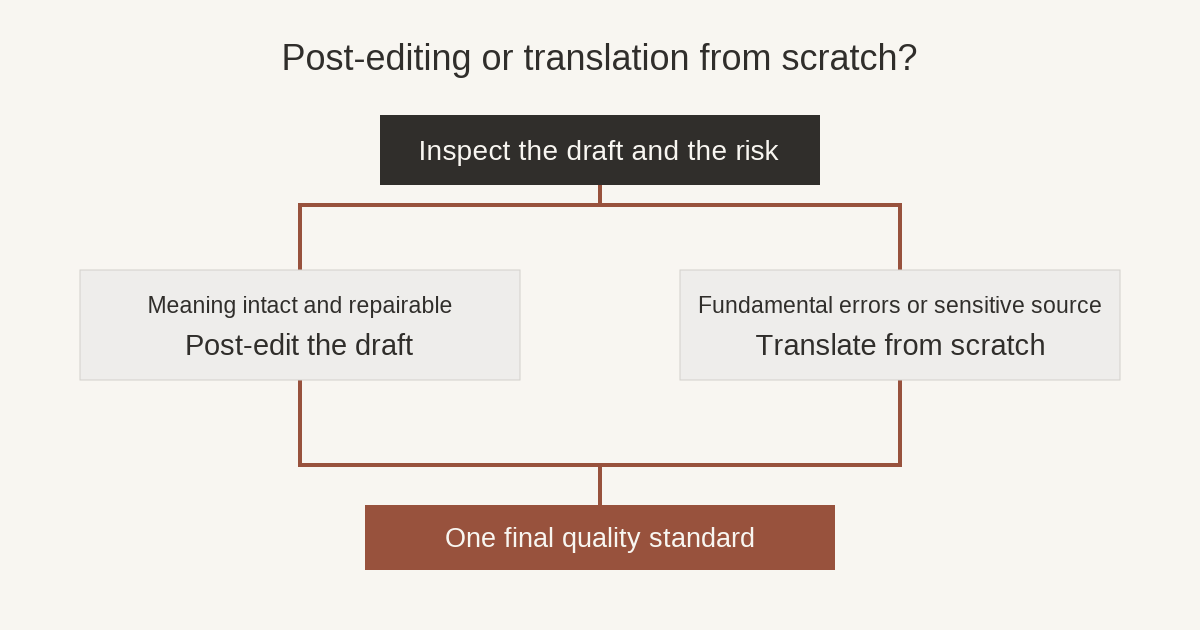
Then separate the requested operations. Specify a translation that preserves qualifications, a summary that retains named elements, or an explanation that distinguishes inference from explicit source material. An instruction such as "make this better" leaves the model broad discretion and makes failures harder to diagnose. Keeping the source, model version, instructions and approved output creates a useful record when the workflow changes.
A glossary constrains vocabulary, not the logic connecting it. An output may use every approved term and still attach an unsupported cause to a result. Approval therefore needs linguistic review and semantic comparison with the source. Depending on the document, one qualified reviewer may handle both, or responsibilities may be divided. Either way, ownership should be explicit.
Does review erase the efficiency gain?
That is a serious objection. If verification consumes too much time, automation may offer little economic benefit. The answer is to evaluate bounded uses rather than apply one approval process to every sentence. Teams can test assistance with organisation, headings and source-based drafting, while treating material claims, forecasts and conditions as explicit approval points.
Measure time to an approved version, substantive corrections and work returned after review. Time to a first draft captures only part of the cost. A slower model could be more useful for a particular task if it reduces correction effort, but that needs internal measurement rather than an assumption about quality or speed.
Human review is also fallible. Reviewers need a clear source, enough time and a defined brief. "Check the language" encourages attention to wording; the job may require checking quantities, attribution and certainty. Naming those checks makes the approval decision easier to explain and audit.
Trust a tested workflow, with stated limits
The editorial recommendation is a bounded delegation: a defined model, a known task, identifiable sources and an accountable approver. Expand that delegation when evidence from the task supports it. A newer release or a more persuasive draft is a reason to evaluate again, not automatic grounds for broader authority.
One question remains particularly useful: can the organisation detect a missing qualification as consistently as it detects a wrong number? If not, its acceptance criteria need attention alongside its choice of tool. In financial writing, preserving a short word such as "may" can be part of preserving the claim itself.
Sources and further reading
- SAHM — ACL 2026
Research findings are limited to the benchmark tasks; no universal production error rate is inferred.
- ArabicMMLU — Findings of ACL 2024
Referenced for evaluation design, not as a ranking of current models.