
Short answer
Diagnose the problem before choosing a service
Correcting punctuation will not solve an unclear argument or scattered information. Conversely, rebuilding approved copy at the final design stage can disrupt space, sequence and approvals.
Provide a representative sample and request an assessment. The scope should explain whether the work includes sentence changes, paragraph restructuring, source checks or only defined corrections.
What can editing include?
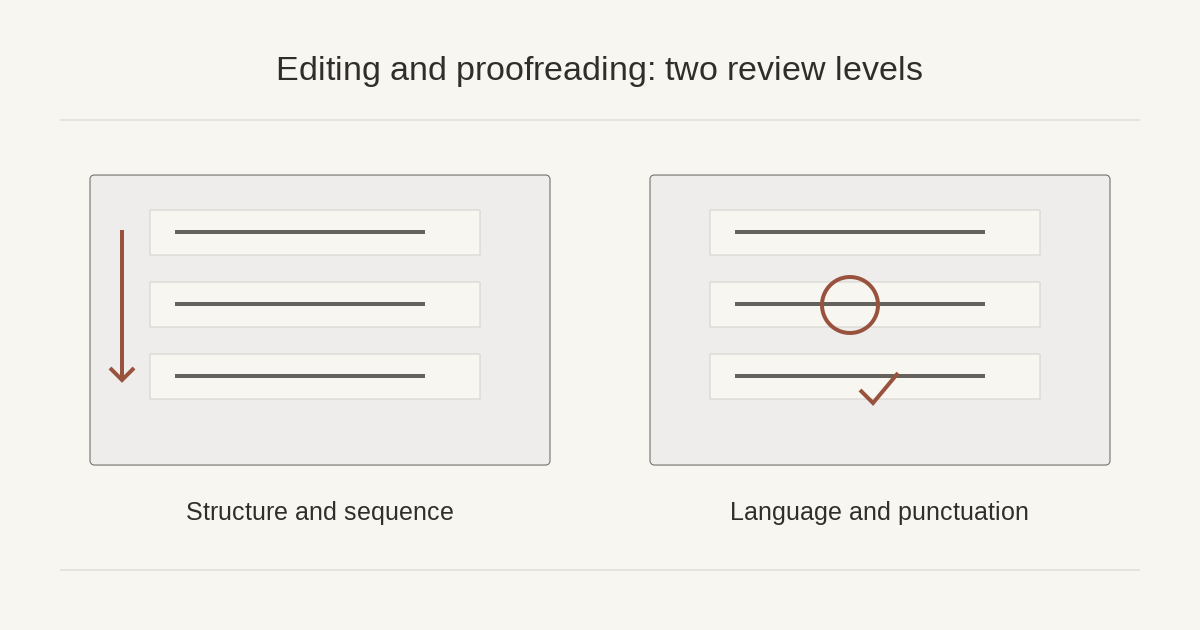
It may address structure and argument, or focus on sentences, repetition, terminology and voice. CIEP distinguishes structural, detailed editing and final checking stages within a publishing workflow.
Editorial freedom does not mean permission to change facts or invent claims. Questions requiring the content owner should be recorded, and specialist or commercial information approved by the responsible person.
What does proofreading include?
In a typical publishing process, proofreading follows editing and layout. It checks remaining errors and issues introduced during production. In some Arabic-language service offers, the same label is also used for correcting language in an editable document.
Clarify this distinction in the brief. Specify whether headings, tables, captions and text inside images are covered, and whether links and figures are checked against a source or only for presentation.
Three problems, three levels of work
A spelling mistake needs a precise correction. A grammatical paragraph that repeats itself and obscures the benefit needs editing. A page describing the wrong service may need to be rewritten from an accurate brief.
Removing an eligibility condition to shorten an advertisement changes the offer. An edit must preserve necessary information or seek approval for a different formulation.
Does language review verify facts?
Not automatically. An editor may query a doubtful claim, but checking every fact requires an agreed task, sources and appropriate expertise. A proofread label is not scientific or legal approval.
For translation review, supply the source text if meaning must be checked. Reading only the target language can identify awkward writing but cannot establish whether a qualification was omitted or an unsupported meaning added.
Prepare the files and references
Supply the latest version, delivery requirements and a person to consolidate feedback. Add the style guide, terminology list and sources for figures and claims, with clear limits on changes.
- Editable text and the designed version if final presentation is in scope.
- The matching source version for translation review.
- The intervention level, feedback rounds and content-freeze point.
- A method for recording changes and resolving editorial queries.
Approve the version that will actually be published
Resolve substantive edits first, then stabilise the copy and transfer corrections into the design where needed. Check the actual publication file rather than an earlier version.
Assign responsibilities across writing, review, design and approval. If information changes after proofreading, identify which parts need another check before release.
Sources and further reading
- CIEP — About proofreading and editing
- CIEP — Copyediting and proofreading
Primary background reference. The practical examples and commissioning guidance are editorial recommendations prepared by Sard.


